


You’ve finalised your plot. Your architect has signed off the drawings. Your contractor is ready to break ground. And then someone asks: “What tiles do you want for the roof?” Most Goa homeowners answer this question the same way, they ask their contractor to pick something mid-range, or they go with whatever’s cheapest at the nearest supplier. It’s a decision made in five minutes. And it’s often one they regret for the next twenty years.
Because in Goa, your roof doesn’t just sit on top of your home. It takes a beating that roofs in Pune, Delhi, or even Mumbai never face. Five months of monsoon hammering. Pre-monsoon heat crossing 35°C. Salt air rolling in off the Arabian Sea. Humidity that never really leaves. And a cyclone risk that’s officially rated high, meaning there’s more than a 20% chance of damaging wind speeds hitting Goa in any given ten-year window.
Your tile choice needs to answer to all of that. Here are the five checks that matter before you buy.
Check 1: Protection Against Strong Winds
Most people think about tiles falling through their roof. They should be thinking about tiles flying off it.
Goa’s coastal position means monsoon winds regularly exceed 60–80 km/h. During cyclonic events, Goa has experienced direct hits, including Cyclone Tauktae in 2021, gusts can go far higher. A roof tile that isn’t properly rated, interlocked, or bedded down becomes a projectile hazard to your home and your neighbours’.
What to check: Ask your supplier for the tile’s wind uplift resistance rating. Well-manufactured ceramic tiles with a deep interlocking profile grip each other and the batten, reducing the chance of individual tiles lifting under suction. Thin, light, or poorly profiled tiles, no matter how they look. are the first to go in a storm.
Telhado tip: A hip-style roof combined with the right interlocking tile profile offers the best wind resistance geometry for Goa homes. Never cut corners on ridge and hip mortar bedding, that’s where most wind damage starts.
Check 2: Protection During Heavy Rains
Goa doesn’t just get rain. It’s an event. July alone can dump close to a metre of rainfall — driven hard by Arabian Sea winds that push water sideways as much as down. Your tile needs to handle not just volume, but velocity and direction.
The two failure points in heavy rain are simple: water pooling on a flat or low-pitched tile, and water being driven upward under the tile by wind pressure. Both cause leaks, rot the timber structure underneath, and invite long-term damage that’s invisible until it’s expensive.
What to check: Look for tiles with a minimum slope recommendation of 30°, and a double-channel or S-profile that actively directs water off the surface rather than letting it sit. Non-porous ceramic tiles are also critical, a tile that absorbs water becomes waterlogged, heavier over time, and prone to cracking when temperatures drop post-monsoon.
Telhado tip: Ask for the tile’s water absorption rate. A quality ceramic roof tile should test at under 6% water absorption. Cheaper clay alternatives often absorb far more, adding dead load weight and shortening the roof’s structural life.
Check 3: Heat & Sun Protection
Between October and May, Goa bakes. Pre-monsoon temperatures hit 35–36°C and stay there for weeks. But the more damaging figure isn’t the air temperature — it’s the surface temperature of a tile under direct afternoon sun, which can reach 60–70°C on dark or poor-quality materials.
This matters in two ways. First, it directly heats your home from above. A tile with poor thermal properties transfers that surface heat into your roof space and then into your living rooms — making your top floor unbearable without air conditioning running constantly. Second, repeated expansion and contraction from UV exposure degrades inferior tiles faster, causing fading, surface crazing, and eventually cracking.
What to check: Ask about the tile’s solar reflectance index (SRI) and whether the colour is through-body or surface-coated. Surface-coated tiles look great in the showroom and fade within three monsoon cycles. Through-body colour, baked into the clay itself during firing, holds its appearance for decades and doesn’t peel, chip, or need repainting.
Telhado tip: Kaolin clay tiles have a naturally lighter base material with higher thermal reflectance than standard red clay. This alone can reduce indoor roof-space temperatures by several degrees, without any coating or treatment.
Check 4: Built for The Coastal Climate
If your home is within 5 kilometres of the coastline, and in Goa, most homes are, salt air is silently working on every surface of your property every single day. The damage is invisible for years. And then suddenly, your tiles are pitting, your mortar joints are crumbling, and your roof is leaking from a dozen places at once.
Salt-laden air causes a specific type of surface degradation called efflorescence in porous materials, white crystalline deposits that form when salts penetrate a surface, then expand as moisture cycles through. On a porous or poorly fired roof tile, this process progressively weakens the surface, causing spalling (surface flaking) and structural brittleness over time.
What to check: A fully vitrified or high-fired ceramic tile is essentially non-porous at the surface, giving salt crystals nothing to penetrate and no surface to degrade. Test this yourself in a showroom: pour a small amount of water on the tile surface. Does it bead off immediately, or does the tile absorb it? A tile that absorbs water will absorb salt air too.
Telhado tip: Always ask whether the tile has been fired above 1000°C during manufacture. At this temperature, the tile body vitrifies, meaning the clay particles fuse into a dense, near-impermeable surface. Below this, tiles remain porous and vulnerable.
Check 5: Stay Free from Moss & Algae
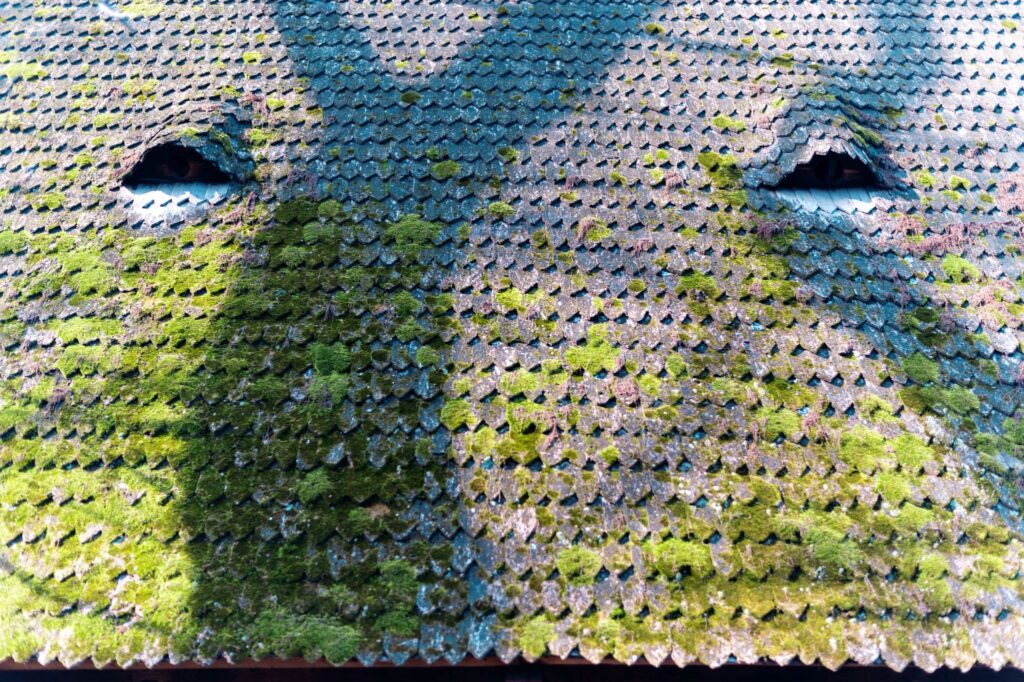
Here’s a question every Goa homeowner should ask: why do some roofs stay clean and some turn green every monsoon? It’s not a location. It’s not luck. It’s the tile surface.
Moss, algae, and fungal growth need three things: moisture, warmth, and something to grip onto. Goa’s monsoon provides the first two in abundance for five months straight. The third is entirely down to your tile. A rough, porous, or textured tile surface gives microorganisms exactly the foothold they need. Once established, moss root systems slowly penetrate tile joints, expand during wet seasons, and force mortar apart, eventually creating leak paths that compound every year. Beyond structure, there’s the visual damage. A moss-covered roof ages a home by decades, reduces curb appeal, and in Goa’s growing villa rental market, directly affects how guests perceive, and review, your property.
What to check: Ceramic tiles with a smooth, dense fired surface give moss and algae nothing to cling to. Unlike coatings or anti-fungal treatments (which wear off), the resistance comes from the material itself. Ask specifically whether the tile surface is smooth-fired or textured, and whether any protective finish applied will need to be reapplied over time. Telhado tip: The non-porous surface of a high-fired ceramic tile doesn’t just resist moss , it means cleaning is faster, less frequent, and requires no harsh chemicals that could damage the tile or the surrounding environment.
The Bottom Line
Buying roof tiles for a Goa home isn’t the same as buying them anywhere else in India. The five factors above, wind, rain, UV, salt, and moss, combine into a unique set of demands that only a tile designed and proven for tropical coastal conditions will meet over the long term. The cost difference between a tile that passes all five checks and one that fails them is often less than ₹10–15 per tile. The cost difference in repairs, replacements, and maintenance over a decade? That can run into lakhs. Your roof will outlast your furniture, your paint, and probably your kitchen remodel. It deserves more than a five-minute decision.
Monsoon is here . Is Your Roof Ready?If you’re building or re-roofing this season, now is the time to get the tile spec right. Contact us today.